

By Liz Schurman, Consultant & Miranda Brekke, Engagement Manager
Oncology has more approved therapies, and more field teams behind them, than at any point in its history. The people those teams need to reach, the providers and payers who shape access, have not grown in number, and they are harder to get in front of than ever. The old challenge was getting in the door but the harder one now is being worth the visit. When many teams compete for the same narrow slice of a stakeholder’s attention, volume stops working, and the teams that gain ground are the ones whose presence is actually useful.

The Math Has Shifted
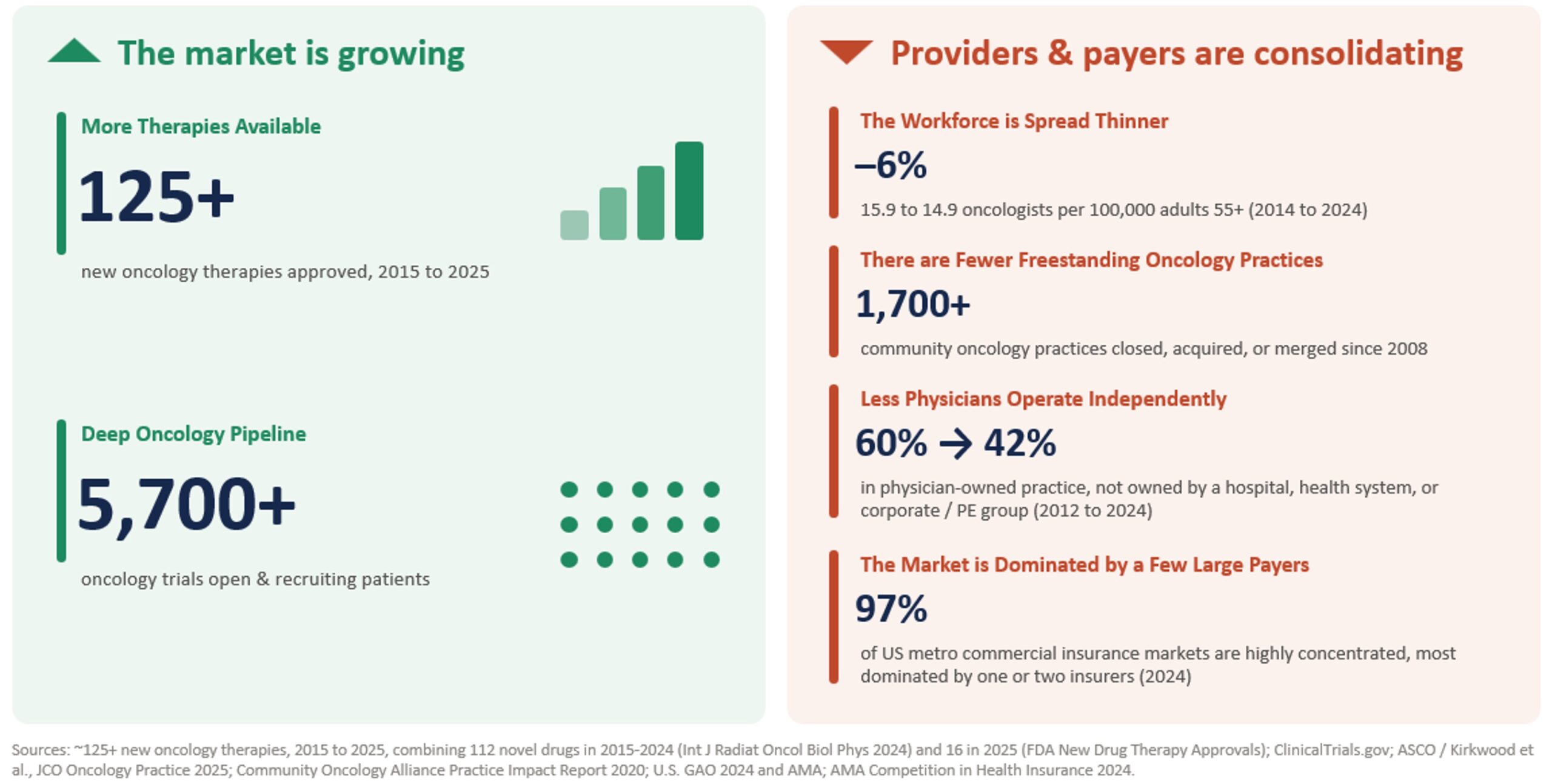
The number of therapies competing for attention keeps climbing. The FDA approved roughly more than 125 novel oncology drugs between 2015 and 2025,1,2 and each year brings dozens more approvals that expand existing drugs into new indications and populations.3 More than 5,700 oncology trials are recruiting across the US today.4 Every one of those programs arrives with its own field team, and often its own account- and payer-specific strategy, seeking time with the same decision-makers.
Those decision-makers are not multiplying to match. The number of oncologists per capita fell about 6% between 2014 and 2024 even as the raw headcount grew, given the rising demand and pace of the aging population.5 At the same time, the settings where cancer care is decided keep consolidating: more than 1,700 community oncology practices have closed, been acquired, or merged since 2008,6 the share of physicians in independent practice has fallen from 60% to 42%,7 and on the payer side, 97% of US commercial insurance markets are now highly concentrated.8
Fewer, larger, and more guarded points of entry now exist, on both the provider and payer sides, meaning access is only getting tighter. What access remains is also split across a growing number of competing teams, so the attention any single team can claim keeps shrinking, resulting in more programs and more teams chasing fewer, busier, and more consolidated stakeholders.
Why Adding Volume Stopped Working
Volume stops paying off because access is capped by forces no single brand controls. As health systems and practices consolidate, the layers between a field team and the people it targets including prescribers, pharmacy and reimbursement leads, and payer decision-makers, keep multiplying. Adding another team against that wall does not create new access, but rather redistributes a fixed amount of attention, often pulling it away from a manufacturer’s own other priorities.
Many manufacturers now carry several oncology brands, so a single organization can be a target for several of that manufacturer’s own teams at once. Much of the strain is self-inflicted, as internal manufacturer coordination rarely keeps pace, with each brand running its own outreach calendar, and no one accounting for the combined volume a stakeholder is absorbing. The pile-up is obvious from the stakeholder’s side even when no individual team looks unreasonable from the inside.
Which Field Team Behaviors Are Expected, and Which Are Rewarded
Not every good behavior earns credit. Some are the price of admission as baseline expectations, noticed only when they slip, while others are what make a stakeholder remember one manufacturer over another.
Two conditions are expected at baseline, and neither is a differentiator. The first is coordination, including showing up as one organized team, without duplication across a manufacturer’s brands and functions. Stakeholders assume it, so it earns no praise, but when it breaks down it is often the first thing they raise. The second is basic competence, meaning being accurate, prepared, and respectful of the time and boundaries of everyone involved. What actually separates one manufacturer from another is narrower, takes more care, and is harder to copy.
Relevance to the role and the decision. A stakeholder is not one audience. A prescriber, a pharmacy director, a reimbursement lead, and a payer medical director have different jobs and different questions. Content pitched at the wrong one reads as poor preparation and wastes a conversation that could not go anywhere. The teams that tailor to who is actually in the room stand out, because few do it consistently.
Bringing something new. When meetings are scarce, a check-in with no clear purpose wastes time on both sides. A conversation that carries new clinical, access, or economic information, however, earns the next one. That is why some stakeholders make time for a team and others stop entertaining them.
Understanding how the organization decides. Larger provider accounts and payers alike run their own processes for how engagement is routed and handled, and they notice who has taken the time to learn them. Working around that process rarely saves time; it usually adds a step and tends to cost credibility.
Adapting to what the stakeholder signals. Organizations notice when a manufacturer listens and adjusts, and they notice just as quickly when nothing changes after repeated feedback. The strongest teams treat that input as operational data where they track it, share it internally, and make sure a change in personnel does not reset the relationship. That level of memory and seamless handoff is rare enough that it registers when a stakeholder encounters it.
What This Means for Manufacturers
None of this is temporary, as the pipeline keeps widening while the provider and payer landscape keeps consolidating, so treating engagement the way it worked five years ago is an expensive bet. The manufacturers gaining ground size their teams to what stakeholders will actually grant, plan at the organization and market level rather than brand by brand, tailor to role and site of care, and measure engagement by whether it mattered rather than how much of it there was.
The teams that gain ground will not be the biggest in the field. They will be the ones providers and payers are glad to see.
See how The Dedham Group’s provider and payer engagement work can inform a more intentional field model. Contact us.
Sources
3 FDA Oncology Center of Excellence, annual reports, 2018-2025.
4 ClinicalTrials.gov, US interventional oncology trials recruiting (retrieved September 2026).
6 Community Oncology Alliance, Community Oncology Practice Impact Report (2008-2020).